
Christ Church Spitalfields
Built 1714-29, Consecrated 5 July 1729
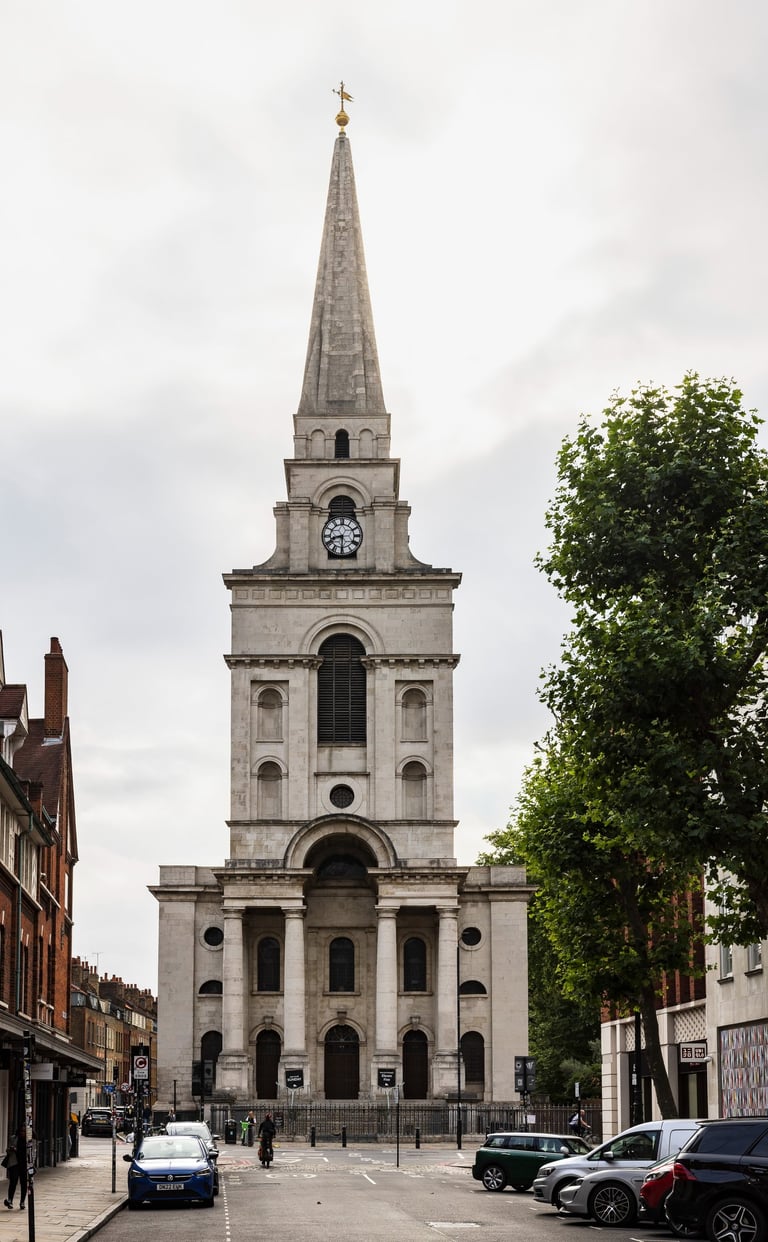
The tower and western elevation
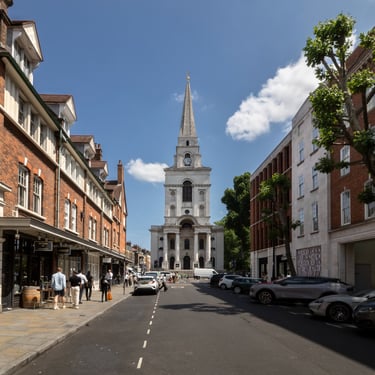
Christ Church Spitalfields must be approached off Bishopsgate, walking east down Brushfield Street. That should be the law. Ideally it should be approached in the winter, when the pollarded trees outside the old Fruit and Wool Exchange building are mere spines and finger bones.
Is it the 'best' of the Hawksmoor churches? I would never offer an opinion on that - it would be like ranking one's children. Let us accept it as probably the most familiar, given its location and the iconic approach.
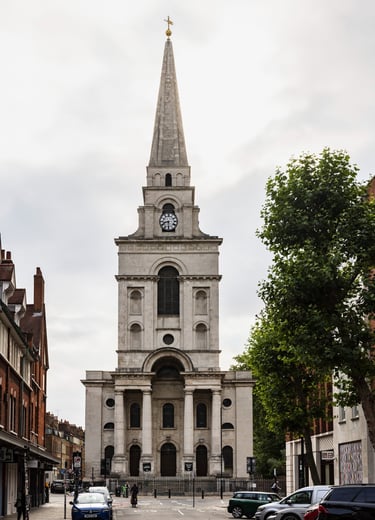
The perfect symmetry of the tower and portico are astonishing - clean lines, nothing as showy as the St George's Bloomsbury off centre ziggurat with king at its pinnacle, or St George-in-the-East's 'pepper pots'. It is 61.5 metres tall (202 feet in old money). You don't need to imagine its impact over the surrounding housing, given much of Spitalfields housing on the surrounding streets is contemporaneous - it soars above them. It is still a series of layers, but the tower is, by Hawksmoor's standards, restrained and elegant, located centrally at the western end.
The layout is also orthodox, running east/west, with the altar at the former and entrance at the latter. It sits atop a shallower flight of steps than many of its siblings, with the tower giving it the scale it needs.
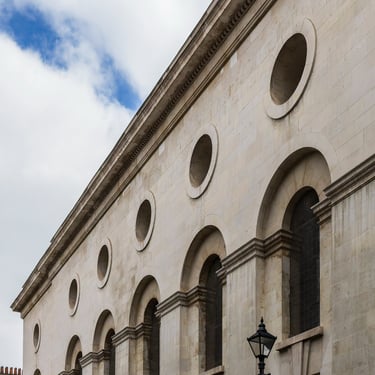
The view from the south and north are also symmetrical - a series of three windows on each side, consisting of a porthole, a large arch beneath and a square window at the base. Why? Not to maximise light in the church (there is a higher row of windows, a clerestory, not visible from the ground as they follow the line of the base of the tower plinth to the eastern end of the building). The arch windows are the largest but are recessed, The square windows bring in light beneath the galleries, which is the darkest part of the church but are too modest to provide significant light. The portholes seem, well, decorative mostly. But in this early eighteenth century world you expect to light the interior of all buildings with candles or oil lamps. Glass is expensive and less secure than solid stone. The world within the church is almost separate from the hurly-burly of Hanoverian London, a place of quiet contemplation, etc. The outside world is THE problem, so best not dwell on what we can see outside of sanctuary. The electric lighting allows one to admire the internal decoration, without shedding too much lux. The addition of coloured lighting is perhaps less suitable for such a setting, but adds atmosphere of a kind.
From top, left to right: 1. View from Brushfield St; 2. Tower from Commercial St; 3. South façade from the Yard; 4. North façade, Fournier St; 5. Right side of the western facade; 6. Eastern facade; 7. View from the SW; 8. View of the spire from the NW
The windows on the western façade are in a different format - portholes, then a semi-circle above the doors (see the left hand image on the bottom row of the gallery below). Large arch windows are repeated in the Portico. The eastern end contains a bigger window over the altar, which is unusual in the Hawksmoor churches. It sits behind two pillars and a partial pediment, so again is not designed to maximise light.
The Huguenot community found sanctuary in Spitalfields in the late seventeenth century, bringing their silk weaving expertise to the London fashion trade. Like so many of London's immigrant communities, they were fleeing severe repression - the most infamous example being the St Bartholomew's Day Massacre in Paris in August 1572.
Their Protestantism was from the Calvinist or Reformed tradition and they soon opened a number of Huguenot temples in the area. The 1711 Act was partially a response to the 'threat' to the Anglican church from these nonconformist alternatives, as well as a recognition of the need to cater for a growing population. By the early nineteenth century the Huguenot population appears to have assimilated and the majority of its temples had closed.
The Victorians did more damage to Christ Church than the Blitz, with significant changes to the interior. By the time restoration work began in 1957, the Church was at risk of terminal decay. Thankfully its priceless importance was championed by the Hawksmoor Committee. The roof was replaced in 1966 to slow the deterioration of the church. As with St George's Bloomsbury, it took significant investment from the World Monuments Fund in the 2000s to restore the church to as close to its original condition as possible. The Friends of Christ Church Spitalfields raised much of the funding needed to restore the church until it ceased operating in 2018 (job largely done), although its website https://www.christchurchspitalfields.org/ continues to provide useful historic information on the church.



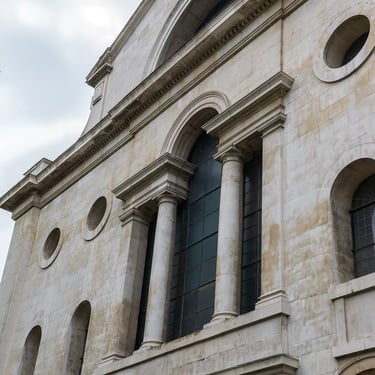
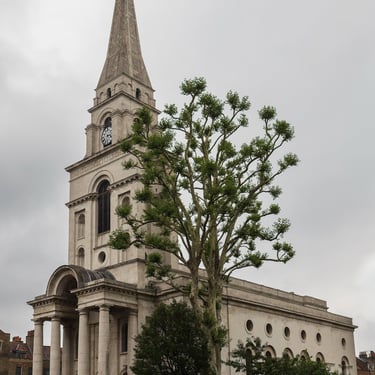
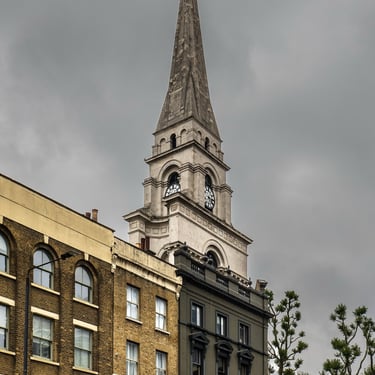

The Portico
Christ Church can give the illusion of being a narrow building when first viewed from the Bishopsgate end of Brushfield Street, a result of the tower's width and significant height. It is also pushed to the front of the building, appearing almost two-dimensional from that angle. As such it dominates the portico, which consists of four columns, two aside supporting a pair of pediments joined by an arch in the centre.
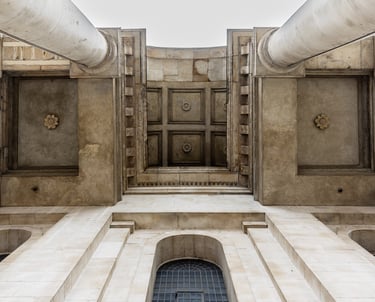
This is a distinctive and unusual design, with no obvious structural purpose. It accentuates the entrance to the church, although the door that sits within the centre is only slightly larger than those to the sides. The three windows above the door are the same size and shape. There is, however, a series of panels designed into the bottom of the arch that can only be seen well from directly below, as in the photo opposite. This is detail beyond necessity, and the building (and we) are richer for it.
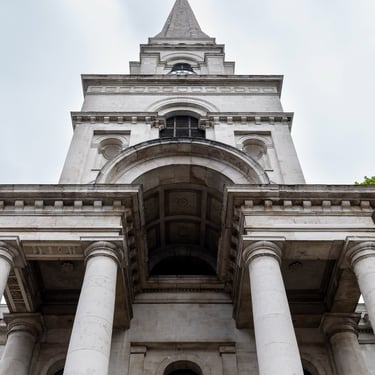
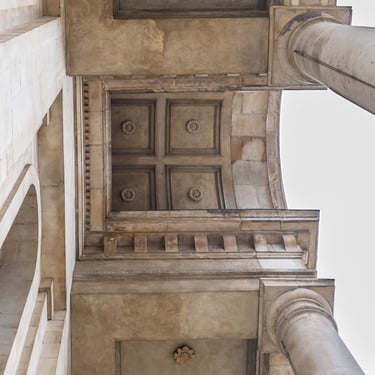
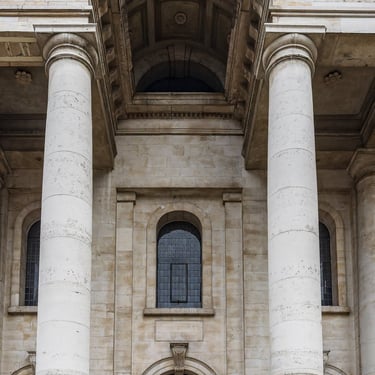
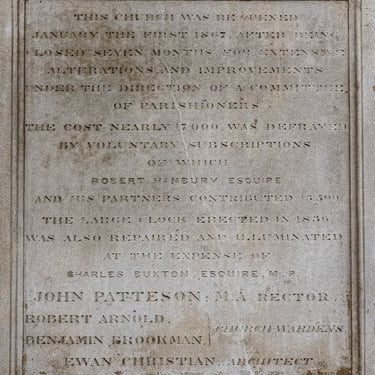
Left to right: 1. Tower and portico from street level; 2. Barrel vaults above main entrance; 3. The portico from street level; 4. Plaque celebrating reopening the church in January 1867 after 'improvements'...


The Interior
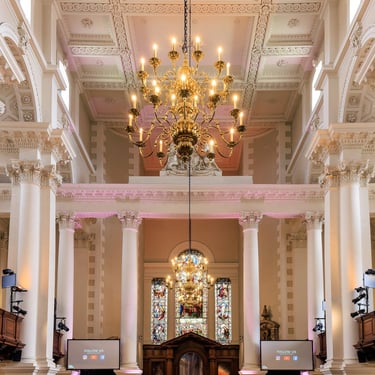
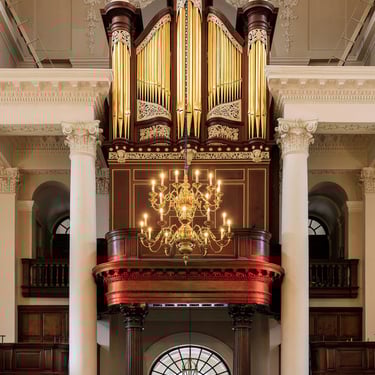
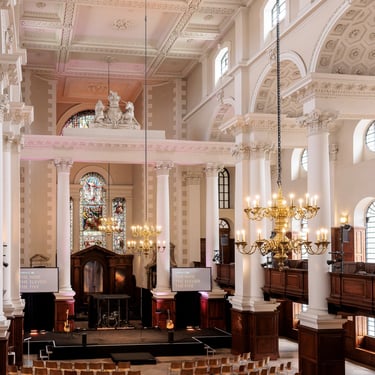
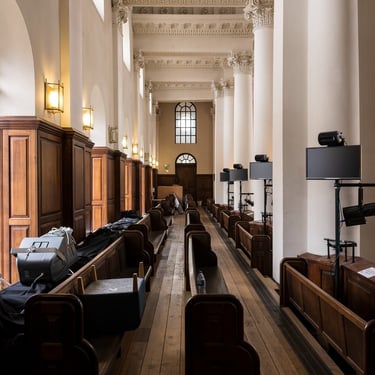
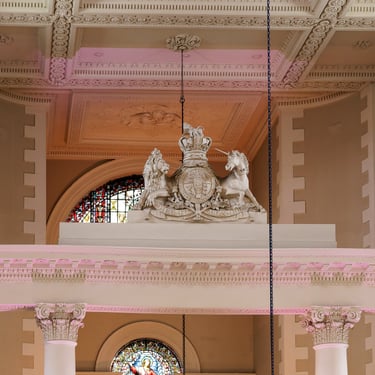
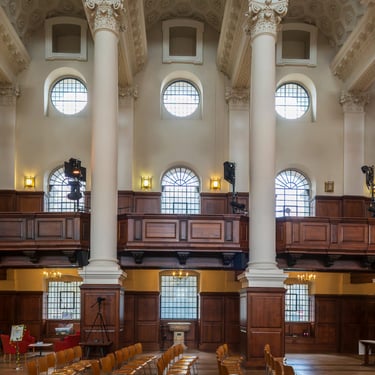
The height of Christ Church's nave still amazes me. It is a cavernous space - 440 square metres, with a 20m high ceiling. The galleries stretch the length of the nave and around the west end, which is dominated by the organ. In common with many of the churches, grand chandeliers provide illumination to the heart of the nave, with electric lights to provide lighting to and below the galleries. Magnificent screens are set at the eastern and western end, the former topped by the royal arms. Church and state clearly intertwined as the times, and the purpose of the 1711 Act, demanded.
The scale of Christ Church and the skill of its restorers do much to support the status of this building as the finest of the six. Again, I cannot make that definitive a judgement, and if St Anne's had received the same investment I think it would be a close call on which is the finest of the larger churches.
From top left to right: 1. View of the nave looking east; 2. The organ and screen, west end; 3. Looking SE from the gallery; 4. Looking east from the gallery; 5. Ceiling over the nave; 6. Looking east on the north gallery; 7. Royal arms on the east screen; 8. Looking north across the nave
More Information
Christ Church Spitalfields is open on Sundays from 1-4pm. I would recommend getting there earlier than later as the doors may shut before 4pm.
The Christ Church website provides some information on Hawksmoor: https://spitalfields.church/heritage
The National Churches Trust has a concise summary of the Hawksmoor heritage: https://www.nationalchurchestrust.org/church/christ-church-spitalfields
Although the Friends of Christ Church Spitalfields are no longer going, their website remains online: https://www.christchurchspitalfields.org/christ-church/history.aspx.html
The excellent Spitalfields Life website has an article on the church here: https://spitalfieldslife.com/2010/05/05/the-secret-world-of-christ-church-spitalfields/
If you are interested in exploring the Huguenots' history in Spitalfields please visit https://www.huguenotsociety.org.uk/blog/blog