
St Alfege, Greenwich
Built 1712-1714, Consecrated 1718, Tower Completed 1730
The History
There has been a church dedicated to the Saxon martyr, St Alfege, on this site since the 11C. Alfege was Archbishop of Canterbury but has the misfortune to be kidnapped by Danish raiders, who murdered him in Greenwich in April 1012. The roof of the church collapsed after a dire storm on 28 November 1710. This became (in part at least) a catalyst for the 1711 Act, after the citizens of Greenwich petitioned the government. They asked if any of the Coal Tax proceeds used to rebuild the City of London churches after the Great Fire could help restore their own. Clearly lobbying has a long (and occasionally successful) history.
Hawksmoor provided the design of the church and oversaw construction. Curiously steeples or towers were not included in the original specification, mainly as a cost saving exercise (yet again, how little has changed!).
The original decision not to replace the medieval steeple was upheld in 1723 when a second petition from the burghers of Greenwich was rejected by the Commission overseeing the Fifty Churches building programme. But the residents of Greenwich were certainly persistent, with further petitions wearing resistance down until it relented. John James, a local architect, designed a new steeple to enclose the old. It is, however, a poor relation to the magnificent towers that Hawksmoor erected. His original design for St Alfege was recycled at St George-in-the-East, a little further upstream on the opposite side of the Thames.
Although this church is very much an outlier in terms of the Fifty Churches Act of 1711 - it was a replacement not a new structure, and was not aimed at restoring Anglican pre-eminence in the face of Jacobin plotting or nonconformist encroachment.
In 1941 a second storm, the Blitz, again destroyed the roof of St Alfege, when two incendiaries caused major damage. The church was restored and reconsecrated in 1953. Other Hawksmoor churches were less fortunate, which is not of course the fault of St Alfege. A bankrupt nation found itself in 1945 with so much damage, human and environmental, to address that many bombsites in British cities were still recognisable as such well into the 1970s.
In many ways the greater miracle is that developers and overzealous planners did not destroy the invaluable heritage Hawksmoor bequeathed to London.
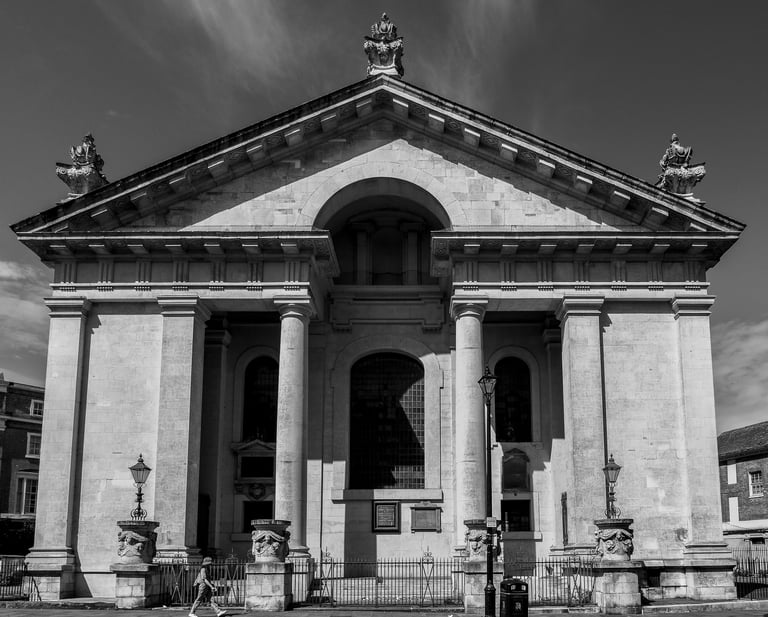
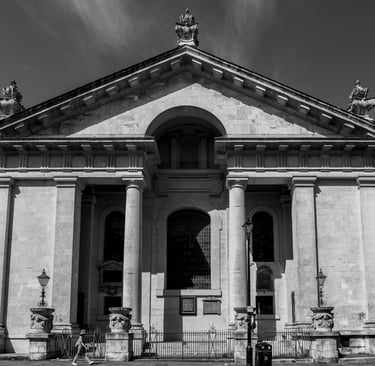
The eastern façade
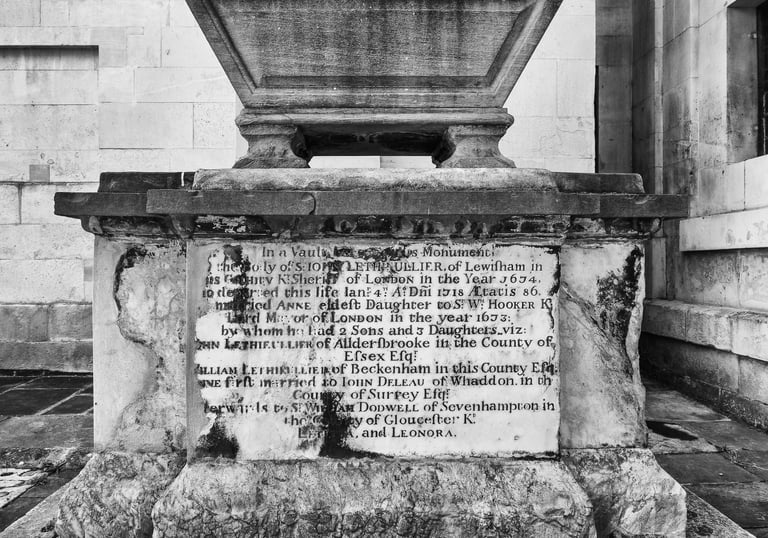
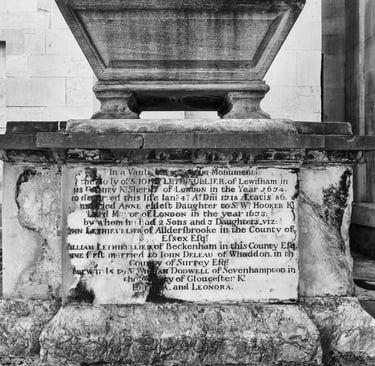
An original memorial within the church grounds

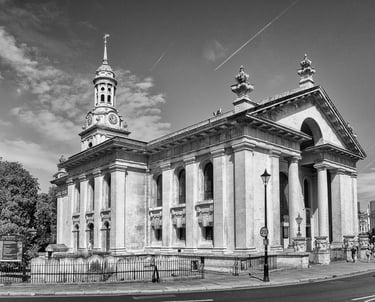
St Alfege's exterior
Photo taken from the south-east, across the road. This clearly shows how the tower is very different to those adorning the Hawksmoor churches. It appears somewhat anaemic compared to Christ Church Spitalfields or St Anne's, in particular.
John James was responsible for re-facing the original spire after further lobbying by local residents to finish the reconstruction. It is unfair to criticise it too readily - without knowing what riches adorn other Hawksmoor churches, one would be quite happy with the spire.
The altar is at the eastern end of the church, as tradition requires, although the main entrances are unusual in being at the sides. Then as now, the eastern approach was a busy road, so the grand façade at that end was designed to ensure the building made the impact expected.
The view looking NE from across Greenwich High Street
St Alfege's Interior
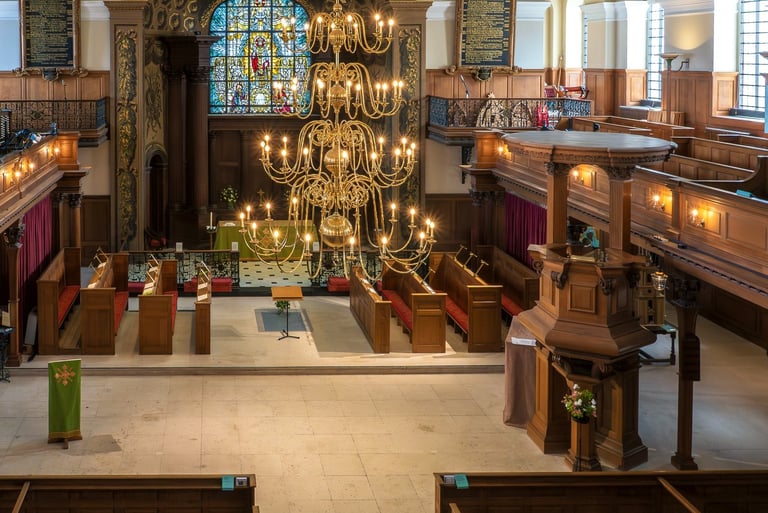
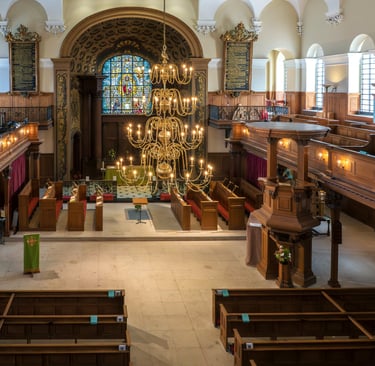
The interior of St Alfege's is pristine. It was masterfully restored to allow it to reopen in 1953 and has been well maintained.
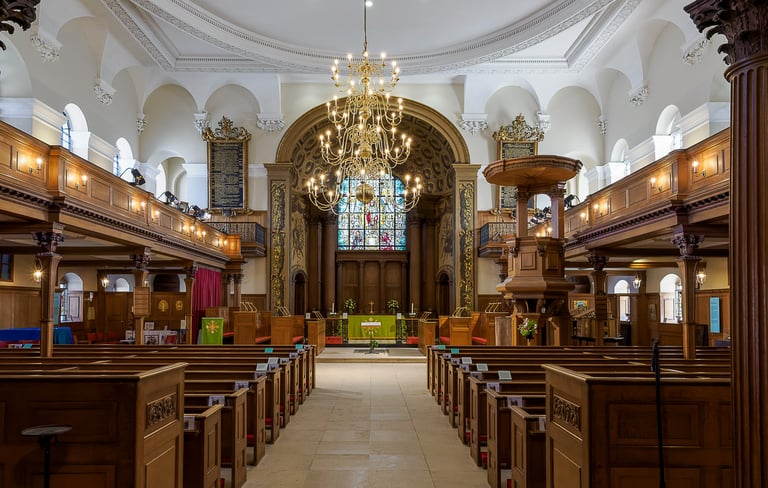
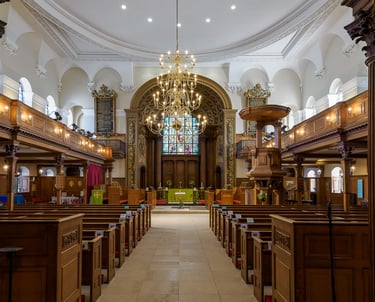
While it lacks the height of Christ Church or St Anne's, it is airier and lighter than both. Large windows at gallery level provide light deep into the broad nave. The decoration within is plain - whitewashed walls and ceilings, simple but elegant wooden pews and galleries.
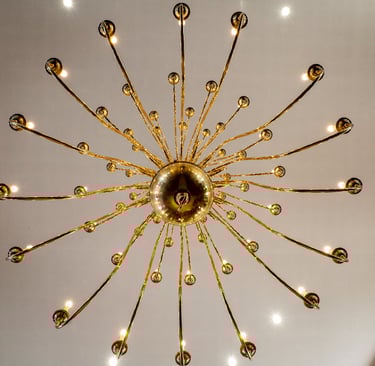
The chandelier, however, speaks to the Baroque origins of the building - a Christmas tree of light suspended between the entrances (the tips of the horizontal beam of the 'cross') on the north and south side. It provides a clear focal point to balance against the relative austerity of the rest of the nave.

Visiting St Alfege
Thanks to many volunteers, the church is open more often than most for a visit. Details of formal tours can be found at https://www.st-alfege.org.uk/Articles/682086/St_Alfege_Church_Heritage.aspx
I was greeted very warmly when I visited to photograph the interior and was shown specific features of interest. It is a beautiful building in a historic setting. I encourage anyone to spend half an hour admiring Hawksmoor's work.
More Information
Visiting information can be found here: https://www.st-alfege.org.uk/Groups/296029/Visit_us.aspx
Specific information on Hawksmoor's involvement in the rebuild is here: https://www.st-alfege.org.uk/Groups/299332/Nicholas_Hawksmoor.aspx
The National Churches Trust is a good source of information on all the Hawksmoor Churches. For St Alfege please visit https://www.nationalchurchestrust.org/church/st-alfege-greenwich